
Treasurer lets gas corporations off the hook and leaves communities facing the cost of worsening climate disasters
12 May 2026
Australians are already paying a staggering price for climate-fuelled disasters - and tonight’s Federal Budget risks leaving communities even more exposed, Serena Joyner, CEO of Bushfire Survivors for Climate Action said today.
“Climate-fuelled extreme weather is costing Australians billions, placing growing pressure on our communities, small businesses and governments. Disaster costs in last year’s budget reached at least $13.5 billion, and this year that figure has risen by $2.5 billion underscoring the scale of the challenge,” Ms Joyner said.
“Despite this, the Federal Budget delivers little in the way of meaningful new investment to help communities better prepare for worsening floods, fires and storms. The budget is a huge missed opportunity to levy the big polluters whose pollution has exacerbated these climate disasters - and governments and communities who will be left with an ever mounting bill.”
“So it’s disappointing that Prime Minister Albanese made a call in this budget not to introduce a genuine tax on gas exports. This would have been a positive step in the right direction. Instead, it leaves communities to pick up the bill.
Communities on the frontline - without enough support
“Communities across Australia are reeling from a summer of disasters that ranged from catastrophic fires to flash floods in Victoria, widespread heatwaves and extreme rainfall. As well as facing the direct costs and harms of those, we are also seeing our insurance and other costs of living get ever more expensive.
“Local governments are facing very significant repair bills, yet remain under-resourced to address these costs. Between 2019 and 2023, 434 of Australia’s 537 councils were impacted by natural disasters. That is also hitting residents hard through cuts to local services and damaged or failing infrastructure.
“The insurance industry warns that councils face “significant and growing” financial and capacity constraints in disaster preparedness and recovery. At the same time, around 242,000 homes face the highest flood risk, with more than 186,000 uninsured for flood damage, leaving households dangerously exposed.
“Insurers and the Australian Local Government Association have called for a major uplift in adaptation and disaster funding, warning that without it, risks - and costs - will continue to rise.
A growing bill for communities
“Without stronger action, the rising cost of climate disasters will increasingly fall on communities and households. It won't just cost people money - it will cost some people their livelihoods, their health, and even their lives.
“Extreme weather is already costing Australia $38 billion each year, with insured and economic losses rising sharply and many impacts going uninsured.
“As insurance becomes unaffordable or unavailable in high-risk areas, our communities and governments are left to pick up more of the recovery bill - locking Australia into a costly cycle of disaster, rebuild, and repeat.
“This Budget does little to break that cycle.
Polluters must pay
“The growing gap between climate disaster costs and funding is a massive budget black hole that raises a fundamental question: who pays?
“Without mechanisms to ensure big gas, coal and oil corporations contribute to the rising cost of climate damage, Australian communities will continue to shoulder the burden through taxes, higher insurance premiums, and out-of-pocket recovery costs.
“The pressure won’t come off the government. People know big gas and coal are not paying their fair share of tax and they want these corporations to pay for their climate damage and the cost of living increases they are forcing onto all of us.
“It’s time to address the broken business model that allows the big coal, oil and gas companies to push the costs of their pollution onto our communities, through the damage we face from escalating climate impacts. Shifting more of the cost burden onto those driving climate pollution would not only be fairer - it would help fund the urgent investments needed to protect communities.
“Without serious investment in climate adaptation and resilience, Australians will continue to pay - through higher costs, greater disruption, and increasing exposure to extreme weather. It’s time the big polluters paid their fair share.
ENDS
For more information or to arrange interviews, please contact Mithra Cox 0425351844
About Bushfire Survivors for Climate Action:
Bushfire Survivors for Climate Action (BSCA) is a non-partisan, community organisation made up of bushfire survivors, firefighters and their families working together to call on our leaders to take action on climate change. BSCA formed in 2018, and its founding members were all impacted by bushfires, including Tathra 2018, the Black Summer bushfires in 2019-20, Blue Mountains in 2013, Black Saturday in 2009 and Canberra in 2003.
BSCA has been at the cutting edge of legal reform to reduce climate emissions and hold governments, agencies and companies to account. In 2021 we took the NSW Environment Protection Authority to court challenging them on their lack of action on climate change and won. Our landmark win in the NSW Land and Environment Court was the first time that an Australian Court ordered a government to take meaningful action on climate change.
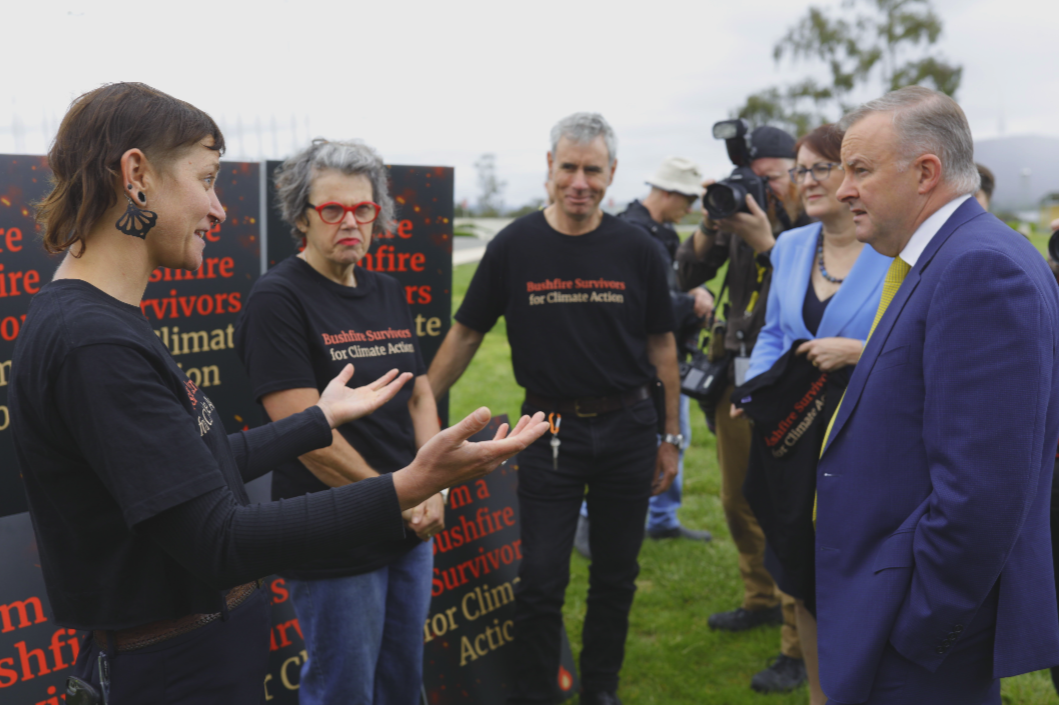
Bushfire Survivors and supporters stand together outside Parliament House, Canberra